

Publication - Optimal Stoppage of Doomed Processes
Most clinical trials fail, and a failing trial keeps enrolling patients who cannot benefit while costing money.
Yet a substantial share of commercial trials run no interim look at all, and those that do typically check only once, near the halfway point, stopping if the treatment appears futile.
But deciding to stop is not stopping: a committee must convene, unblind and act. That delay creates a horizon beyond which looking is pointless, because no time remains to recover.
We ask what is lost by looking only once - and what is lost by never looking at all.
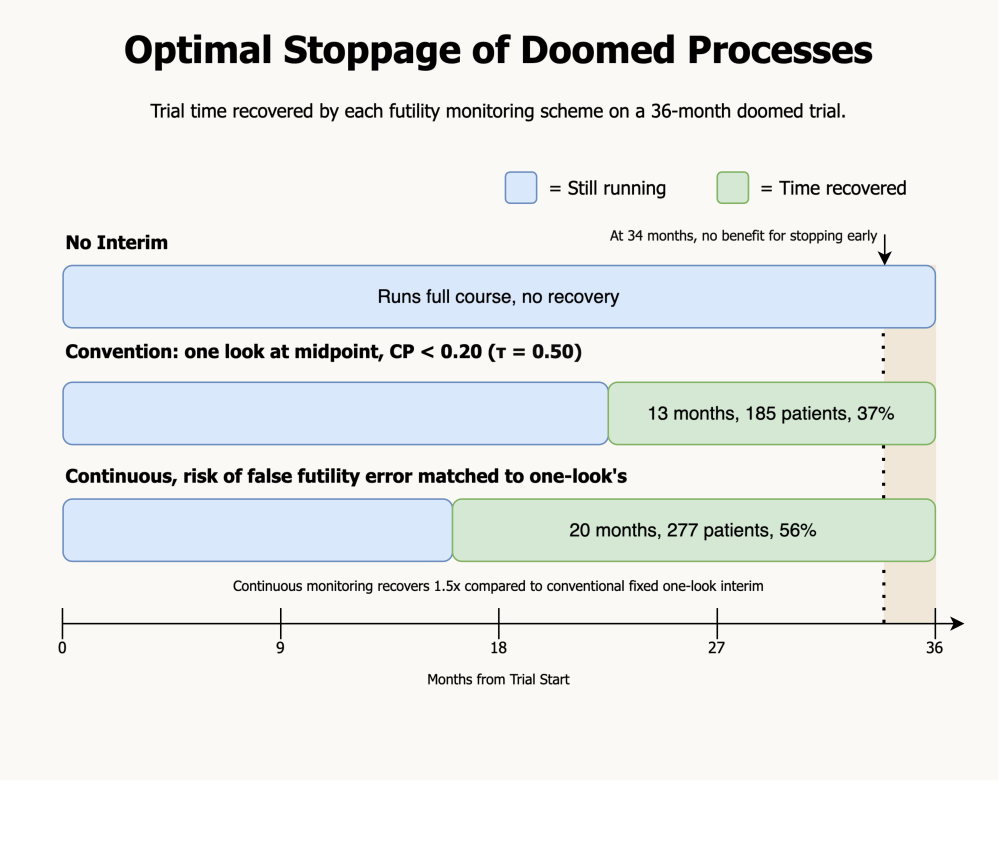
A single look must be either early, when the evidence is weak, or late, when little time is left. Continuous monitoring need not choose a specific time and it reduces false futility against a single look; and protects alpha.
For a canonical 36-month trial, continuous monitoring ends a doomed trial about 20 months early, against 13 for a single look at midpoint.
Read the full paper: Optimal Stoppage of Doomed Processes